Trading Futures with a Prop Firm: What NinjaTrader Traders Should Know
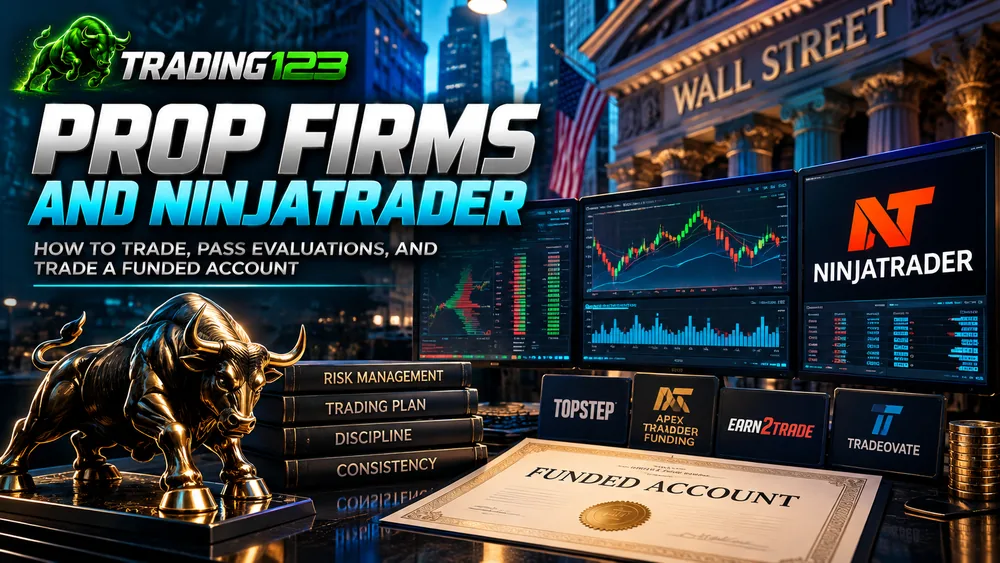
You don't need a large trading account to trade size anymore. Proprietary trading firms — "prop firms" — let you prove your skill on an evaluation, then trade their capital and keep most of the profits. For futures traders on NinjaTrader, it's become one of the most popular ways to scale up. Here's how it actually works.
What a prop firm is
A futures prop firm funds traders. Instead of risking a big balance of your own, you pay a modest fee to take an evaluation. Pass it by hitting a profit target within the firm's risk rules, and you're offered a funded account. From then on you trade the firm's money and split the profits — often keeping 80–95%.
How evaluations work
Most evaluations share the same moving parts:
- Profit target — the amount you need to make to pass (e.g., a set dollar figure on a given account size).
- Maximum drawdown — the most you're allowed to lose. This is the rule that ends most attempts.
- Daily loss limit — some firms cap how much you can lose in a single day.
- Consistency / minimum days — rules to reward steady trading over one lucky session.
Trailing vs. static drawdown
Pay close attention to how drawdown is measured. A trailing drawdown follows your account's peak up during the day, so giving back open profit can breach it — even if you're still green overall. A static (end-of-day) drawdown is fixed and generally easier to manage. This single detail changes how you should trade.
Whichever type you have, size your trades so one losing stop stays well inside the drawdown. Our free futures position size calculator turns your account size, risk percent and stop distance into a contract count — with a max-contracts field for firm limits. To see how many losing trades your drawdown can absorb, use the prop firm drawdown calculator.
| Trailing drawdown | Static drawdown | |
|---|---|---|
| What it tracks | Your account's highest point, including unrealised profit at some firms | A fixed floor set from your starting balance |
| When it moves | Upward as you make new highs; it never moves back down | It does not move, or only moves once you pass your starting balance |
| What breaches it | Giving back open profit, even while still up on the day | Only realised losses below the fixed floor |
| How it changes your trading | Favours taking profit earlier and protecting peaks | Allows wider stops and letting winners run |
A simplified illustration of why trailing catches people out. Say you start at $50,000 with a $2,000 trailing drawdown, so your floor begins at $48,000. You run the position up to $51,200 intraday — your peak — and the floor trails up with it to $49,200. Now you give back $1,600 of that open profit. You are still $1,600 ahead of where you started, and you have breached nothing on a static account. On a trailing account you are $400 from failing. That is the same trade producing two completely different outcomes based only on which rule the firm uses.
Every firm implements this differently — some trail on closed balance only, some include unrealised profit, and some stop trailing once you clear your starting balance by a set amount. The numbers above are illustrative, not any firm's actual terms. Read your own firm's rule before you trade, not after.
Why NinjaTrader traders use prop firms
NinjaTrader 8 is supported by most major futures prop firms, so the tools you already use travel with you. Many firms also offer micro contracts (MES, MNQ, MCL), which let you size positions precisely against the drawdown rules while you build consistency.
How to choose a firm
Compare firms on the factors that actually affect your bottom line:
- Profit split and how quickly you reach the higher tiers.
- Drawdown type (trailing vs. static) and daily limits.
- Payout frequency and minimums.
- Evaluation cost and current discounts.
- Reset and rule flexibility if you have a bad day.
Can you run an automated strategy on a funded account?
Sometimes — and this is the question that costs traders the most money when they get it wrong. If you trade with bots or a copier, read the firm's automation policy before you buy an evaluation. Many firms restrict or limit fully automated trading. Some allow semi-automated setups where you arm the strategy but confirm entries. Some permit automation on funded accounts but not during the evaluation phase. Some ban unattended operation specifically, meaning the strategy may run but you must be at the desk. Assuming and getting it wrong can void an account and forfeit the fee you paid.
Policies also change. A firm that allowed full automation last year may not today, and rules are sometimes tightened after a payout cycle. A screenshot of the rules on the day you bought your evaluation is worth keeping.
The pre-purchase checklist
Before you pay for an evaluation, get a written answer — from the firm's own rules page or support, not a forum post — on each of these:
- Is fully automated trading permitted? If yes, is it permitted during the evaluation, on funded accounts, or both?
- Is unattended operation allowed? Several firms permit automation only while you are present and able to intervene.
- Are trade copiers allowed, and across how many accounts? Copier limits are often stricter than automation limits.
- How exactly is drawdown calculated — trailing or static, on closed balance or including unrealised profit?
- Is there a daily loss limit, and does hitting it end the day or the account?
- What is the consistency rule? Some firms void a pass if one day accounts for too large a share of total profit — which an automated strategy can trigger accidentally on a strong trend day.
- Are there restricted news periods? A strategy that trades the open needs to know whether 8:30 ET data releases are off-limits.
- What are the rules on overnight and weekend positions? Most futures evaluations require flat by a set time.
- Maximum position size, including whether micros count differently from minis.
That list is deliberately firm-agnostic. Specific profit splits, drawdown figures and automation policies change often enough that any article quoting them is out of date within months — including this one, if we tried. Use the checklist against whichever firm you are considering.
Why the consistency rule catches automated traders
This one deserves singling out because it is the least intuitive. A consistency rule caps how much of your total profit can come from a single day — say 30% or 40%. Trade manually and you naturally spread results across sessions. Run an automated strategy through one exceptionally strong trend day and it can bank a disproportionate share of your target in a single session, technically passing the profit target while failing the consistency requirement. If your firm has one, size down or pause the strategy once you are close to the target.
Bringing your edge to a funded account
Because our strategies and indicators run on NinjaTrader 8, the same tools you trade at home can travel to a funded account, within each firm's rules. The Opening Range Breakout Strategy and the Order Flow Strategy are both trade-copier compatible, and the AlgoBot lets you tune risk and target parameters to fit a drawdown rule rather than fighting it.
One practical note on sizing: micro contracts are what make automation and tight drawdown rules compatible. Running MES instead of ES cuts the per-tick value to a tenth, which lets an automated strategy take the same setups at a position size a $2,000 drawdown can actually absorb. Most traders who blow evaluations with a bot did not have a bad strategy — they ran it at mini size against a micro-sized risk budget.
Frequently asked questions
Can you use automated trading with a prop firm?
Sometimes, but never assume it. Policies vary by firm and by phase — some allow full automation on funded accounts but not during the evaluation, some permit it only while you are present at the platform, and some prohibit it outright. Confirm the firm's current written policy before you buy an evaluation, because breaching it can void the account.
Does NinjaTrader work with prop firms?
Yes. NinjaTrader 8 is supported by most major futures prop firms, which is why it is one of the most common platforms among funded futures traders. Your charts, indicators and strategies carry across to a funded account, subject to the firm's own automation rules.
What is the difference between trailing and static drawdown?
A trailing drawdown follows your account's peak upward and never moves back down, so giving back open profit can breach it even while you are still up on the day. A static drawdown is a fixed floor based on your starting balance and is only breached by realised losses below that level. Trailing rules favour taking profit earlier; static rules allow wider stops.
Why do most traders fail prop firm evaluations?
Drawdown rules, not profit targets. Most attempts end because a trailing drawdown was breached after giving back open profit, because a daily loss limit was hit, or because a consistency rule was failed despite reaching the profit target. Understanding exactly how your firm measures risk matters more than the strategy you trade.
Can I use a trade copier on a prop firm account?
Often yes, but copier rules are usually stricter than automation rules and frequently cap the number of accounts you can copy across. Check the limit before you buy multiple evaluations intending to copy between them.
Should I trade micros or minis on an evaluation?
Micros (MES, MNQ, MCL) in most cases, especially with an automated strategy. A micro contract carries a tenth of the per-tick value of the equivalent mini, which lets you take the same setups at a size a typical evaluation drawdown can absorb. Scaling up is a decision for after you are funded and consistent.
Key takeaways
- Pass an evaluation, trade the firm's capital, keep up to ~95%.
- Drawdown rules end most attempts — know trailing vs. static.
- NinjaTrader 8 and micro contracts make sizing manageable.
- Always check the firm's automation policy before you buy.
Trade your edge on funded capital
The AlgoBot runs natively on NinjaTrader 8 with tunable risk and target parameters, so you can size it to a drawdown rule instead of fighting one — and it's trade-copier compatible for running multiple accounts.
Get the AlgoBotEducational disclaimer: This article is for educational purposes only and is not financial advice or a recommendation to trade. Prop-firm rules, profit splits, and offers are set by each firm and can change. Futures trading involves substantial risk of loss and is not suitable for every investor. Past performance is not indicative of future results.